
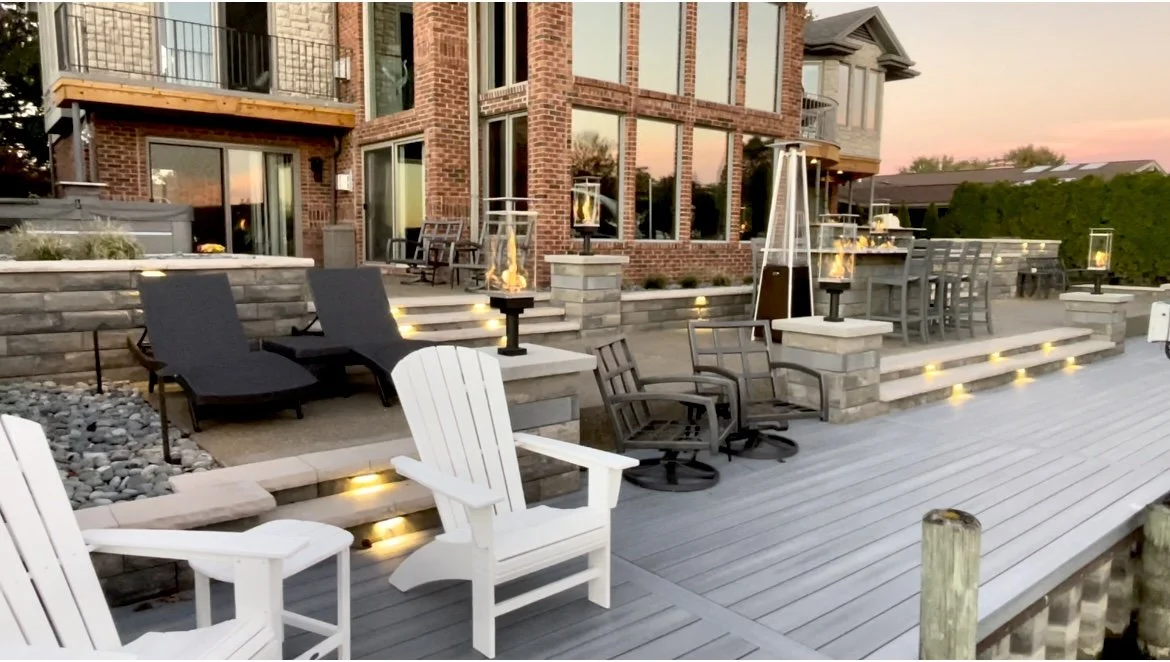
Two proposals for landscaping services in Macomb, MI can carry the same heading and describe very different work, because the phrase is broad enough to mean one bed of shrubs or the entire exterior of a property. The term spans drawing, grading, building and the seasonal attention that follows, and those are not a single trade. Reading a quote well starts with working out which of them sits inside it.
Russell Sheridan founded Legacy Landscape in 2013, and the company is a Unilock Authorized Contractor with one crew, one timeline and one point of contact carrying a project through installation and final review.
Our team has built on properties around Macomb and Oakland counties where the drawing, the construction and the care afterward sat with one company, and on properties where those three were split between separate outfits. The difference rarely shows in the finished photograph. It shows later, in who answers the phone when a joint opens or a bed drains slowly.
This guide covers what the term includes, where design hands off to construction, which items sit inside one agreement and which are quoted on their own, and what continues on a property once the crews have gone.
What Does the Term Landscaping Services Actually Cover?
The term landscaping services usually covers four different kinds of work: design, construction, planting and seasonal care.
Design produces a drawing and a material list, construction moves earth and sets stone, planting puts living material into prepared ground, and seasonal work keeps the result looking the way it did in its first week.
Those four carry different risks and different warranties. A wall that leans is a construction problem. A shrub that fails in its second summer is a planting problem, and sometimes a drainage problem wearing a planting disguise. Separating them on paper before anything starts is what makes the later conversation short.
Our landscape design and construction work covers the first two under one team, which is the practical reason the drawing and the build agree with each other on dimensions, materials and grade.
Where Does Design End and Construction Begin on a Landscape Project?
Design ends and construction begins at the approved plan on a well-run project. Design settles layout, elevations, materials and the position of everything that will later be difficult to move, and construction executes that. The handoff is a document rather than a conversation, and projects that skip the document tend to discover the gap at the point where a wall meets a step.
Site conditions decide more of the design than most homeowners expect. Grade, sun, existing trees and the way water currently leaves the property all constrain what can sit where. A drawing made without those measured is a sketch, and a sketch priced as a plan is where change orders come from.
In southeast Michigan the soil adds its own constraint. Heavy clay holds water and moves with it, which changes base depths, drain locations and what a planting bed needs underneath it. Those decisions belong in the design rather than in a conversation on the morning the excavator arrives.
How Do Existing Trees Change a Landscape Plan?
Existing trees change a landscape plan more than almost anything else on a mature property.
An established tree has a root zone roughly as wide as its canopy, and excavation, compaction or a change in grade inside that zone shows up in the crown within a season or two. The tree usually declines quietly enough that nobody connects it to the patio built three summers earlier.
So the drawing has to decide early which trees stay. Keeping one constrains the layout, the base depth and the equipment route around it. Taking one out changes the sun on every bed nearby, and a planting plan drawn under shade that no longer exists will struggle in its first August.
Our design work measures the canopy spread and the grade around existing trees before the layout is fixed, because those two numbers quietly set the boundaries of what the rest of the plan is able to do.
What Sits Inside One Landscaping Agreement and What Gets Quoted Separately?
Hardscape, structures and the earthwork around them usually sit in one construction agreement because they share a base, a schedule and a crew. Plantings often sit there too when they go in at the same time. Work that recurs on its own cycle is generally quoted on its own, because it is priced per visit or per season rather than per project.
Mulch, decorative rock and edging are the clearest example. They finish a bed at installation, and they are also the thing a property owner wants renewed later, which means they can appear in a build quote and again as separate work two years on. Our mulch, rock and edging work is priced as its own line for exactly that reason.
Drainage is the opposite case. It belongs inside the construction agreement wherever the build changes how water moves, because a patio that redirects runoff into a neighboring bed has created a problem the build caused.
Our yard drainage and French drain work is frequently folded into a larger project for that reason.
What Does a Landscape Material List Need to Say?
A landscape material list needs to name specific units rather than categories.
A line reading paver in a quote could be any of a dozen products at three price points, and the difference between them shows up in thickness, in color consistency and in how the surface behaves after ten freeze cycles. A line naming the manufacturer, the unit, the color and the laying pattern can be compared against another quote honestly.
The same applies to what sits underneath. Base depth, aggregate type and compaction method are invisible in a finished photograph, and they decide almost everything about how the surface looks in year five. A quote that specifies the surface in detail and leaves the base to a single word has described only the part you can see.
Edge restraint, jointing material and the detail where one surface meets another belong on the list as well. Those three are where most settling and separation begins, and all of them are inexpensive to specify correctly at the drawing stage.
How Does a Property Get Handed Between Landscape Construction Phases?
A property gets handed between phases mostly through its elevations and its access routes. The construction crew leaves a site at a particular grade with particular compaction, and the planting crew inherits exactly that. If the finished grade sits two inches high against a foundation, or a bed was compacted by machine traffic, the planting goes in under a handicap nobody wrote down.
Access is the other half. Heavy equipment needs a route, and that route crosses lawn, beds or a driveway that may itself be part of the finished work. Sequencing the drive last and the excavation first sounds obvious, and it is one of the most common things to go wrong when separate companies are scheduled independently.
Our planting work is scheduled against the construction calendar rather than beside it, so beds are prepared after the grade is final and before edging and surfacing close them in.
Where the Construction-to-Planting Handoff Usually Slips
The handoff usually slips in two places: topsoil and low-voltage sleeving. Topsoil goes wrong when nobody records how much was stripped, where it went and how much came back, and a bed rebuilt on subsoil struggles for years.
Sleeving goes wrong on timing. Conduit for lighting and irrigation has to be in the ground before a surface closes over it, and both topsoil and sleeving are cheap at the right moment and costly afterward.
Related: Creating a Lush Paradise: Pairing Plantings With Your Inground Pool in Rochester Hills, MI
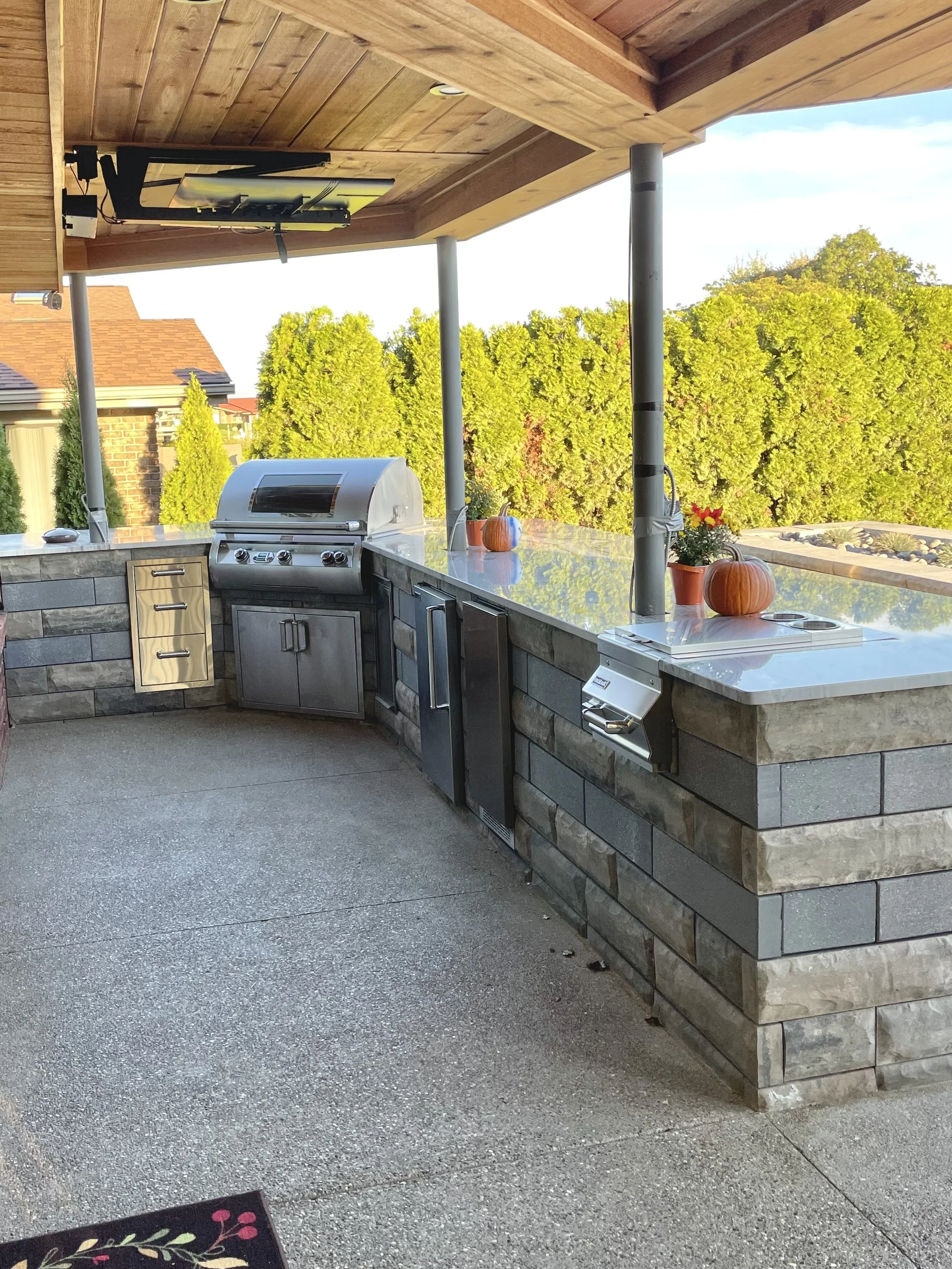
Which Work Continues After a Landscape Build Is Finished?
Less work continues after a well-built landscape is finished than people fear, though it is more than nothing.
Beds want their mulch and their edge lines renewed on a cycle. New plants want water through their establishment period, which around Macomb runs through the first full season. Drain outlets want keeping clear.
Plant selection decides much of how much attention a bed asks for later. Species chosen against the sun, soil and exposure they will actually live in settle into a position and hold it. Species chosen for a photograph rather than a position create standing work for somebody.
Snow and ice management is its own agreement, with its own season and its own equipment, and it is quoted separately for that reason. A property designed with winter in mind gives the plow somewhere sensible to put what it moves, and that is a design decision made long before the first storm.
What Should Be Settled Before the First Landscape Crew Arrives?
Six things should be settled before the first crew arrives, and all of them are cheap to settle on paper. The drawing side covers the finished elevations, a material list naming specific units rather than categories, and the utility and sleeving routes.
The site side covers the access route, where material will be stockpiled, and the sequence of trades, including who carries responsibility for the grade at each handoff.
A contractor who can answer those without checking has thought about the property. One who answers with a number and a start date has thought about the schedule. Both matter, though only one of them predicts what the landscape looks like in five years.
What Does a Final Landscape Walkthrough Confirm?
A final walkthrough confirms that the built work matches the drawing and that everything in it runs. That means checking elevations at the critical points, confirming drain outlets flow freely, seeing lighting aimed and switched to the right circuits, and making sure gates and doors close square.
It is also the moment to record what was actually installed. Unit names, colors, fixture types and lamp wattages are easy to collect on the last day and awkward to reconstruct three years later, when something has to be matched.
Our team closes out a project with that record alongside the as-built elevations, because the next phase, the next contractor and the next repair all start out of it.
A property owner holding that paperwork is in a far stronger position than one holding a folder of invoices.
How Should Landscape Work Be Phased Across Seasons?
Landscape work is generally phased with design in the quiet months and construction when the ground allows.
Drawing, material selection and approvals occupy the part of the year when crews cannot dig, which means a project designed over winter starts earlier in spring than one that begins with a January phone call.
Phasing also lets a property owner spread a large scope without losing coherence, provided the whole design exists first. Building phase one against a complete drawing keeps the base, the drainage and the sleeve routes correct for phases that arrive later. Building phase one against phase one alone usually means opening it again.
The practical test is that the later phases are drawn, not that they are priced. Prices move. Dimensions, elevations and sleeve locations are what phase two actually needs out of phase one.
What Separates a Full-Service Landscaping Company From a Single Trade?
A full-service landscaping company is separated from a single trade by responsibility at the seams.
A paving crew is responsible for paving, and a good one does it well. A company carrying the whole property is responsible for the places where paving meets grade, grade meets planting, and planting meets the drainage that keeps both alive.
That matters most when something goes wrong, because the seam is where most problems sit. Water appearing at the base of a wall could be a wall problem, a grade problem or a downspout problem, and three separate contractors will each correctly identify it as one of the other two.
It also matters at the quoting stage. One scope covering the property can be compared honestly against another. Four scopes from four trades have to be assembled before they can be compared at all, and the gaps between them are rarely visible until somebody is standing in one.
Landscaping Services in Macomb, MI Planned Across the Whole Property
A property reads as one piece of work even when it was built in stages, and what makes it read that way is a drawing that covered all of it before the first phase was priced.
Our team would rather walk the grade, look at where water goes and draw the whole property before quoting any part of it.
Legacy Landscape treats landscaping services in Macomb, MI as one scope across design, construction and the seasons that follow, and a visit to the property is where that begins.
Schedule your landscape design consultation with Legacy Landscape.
In Summary
Can landscaping services in Macomb, MI be phased across more than one season?
Landscaping services in Macomb, MI can be phased across several seasons, provided the full design exists before phase one is built. The elevations, drainage runs and any sleeving for lighting or utilities have to be set for the whole property at the start, because those are the parts a later phase cannot add without opening finished work. Pricing can follow the phases; the drawing cannot.
How long does a design take before construction can be scheduled?
A design typically takes several weeks between the first site visit and an approved plan on a project of any size. The visit, the measurements, a first layout, one or two rounds of revision and a final material selection each take time, and material lead times sit on top of that. Projects that begin their design in the fall are generally the ones that break ground earliest in spring.
Does one company carrying both design and construction change who is responsible for drainage?
One company carrying both design and construction consolidates responsibility for drainage. Where Legacy Landscape drew the grade and built to it, a drainage problem has one owner and one conversation. Where the drawing came from one party and the construction from another, responsibility usually turns on a comparison between the built grade and the drawn grade, which is why the approved plan and the finished elevations are worth keeping.